

Fundamentals of Professional Printing. How is Print Marketing Still Relevant?
Businesses use professional printing to produce high-volume printed materials for commercial purposes. This printing supports their communication, marketing, and brand promotion efforts. It includes different techniques, including desktop printing, commercial digital printing, offset lithography, engraving, and more. Business owners must know about different colour profiles and the stages of professional printing before starting any printing run. It would help them select the most appropriate printing method, paper stock, colour profile, and finishing options for their project. This blog will tell you everything about the basics of professional printing and how print marketing is still relevant in 2026.

Key Takeaways
- Professional printing helps in producing high-volume printed materials for commercial use.
- It depends highly on skilled professionals, specialized machinery, and paper stocks.
- People give more value and feel connected to printed media.
- Professional printing provides diverse formats like business cards, postcards, letters, brochures, etc.
- Businesses commonly use desktop printing, professional digital printing, offset lithography, and engraving.
- CMYK colour profile is the gold standard of professional colour printing.
- Print marketing gains more attention and remains more memorable than digital messages.
What is Professional Printing?
It refers to producing high-volume printed materials for commercial purposes. These materials are often vital for communication, marketing, and brand promotion. Professional printing highly depends on skilled professionals, specialized machinery, and paper stock.
Businesses use this printing approach to produce business cards, postcards, letters, flyers, posters, catalogues, and magazines. It remains an integral part of any business strategy, even in the digital age of 2026.
Benefits of Professional Printing for Businesses
Professional printing has dynamic applications in different industries. It gives a tangible medium to convey your message, completing the existing digital marketing strategies. People feel more attached and connected with printed materials than digital messages. Many global brands actively use professional printing to achieve their marketing and communication goals. Here’s why:
Strong Marketing
Online marketing dominates the advertising world because it offers more convenience and reach. However, professional printing still has the advantage of being practical. It can target a specific audience, grab their attention, and convey a brand message.
Higher Professionalism and Credibility
Digital messages are more accessible to any individual or business, making them less credible. On the other hand, professional printing helps you create stunning brochures, business cards, or postcards to build your credibility and professionalism. People give more value to brands that put effort into producing printed materials.
Highly Targeted Approach
Businesses that use professional printing can tailor their printed materials for specific audiences. They rely on their digital systems to fetch user data to personalize individual messages, offers, and images precisely. Professional printing allows you to cater to personal tastes and preferences while drafting your marketing messages.
Versatile Formats
Digital messaging keeps you confined to the digital device your recipient is using. For instance, an email won’t have the charm of a physical personalized postcard. The tactile feel makes every printed message more memorable than digital messages. Plus, you can experiment with many different formats, such as business cards, postcards, brochures, newsletters, etc. This level of versatility suits different marketing strategies and objectives.
Supports Brand Identity and Recognition
A user might ignore or delete your digital message even if you put your best efforts into design consistency. Professional printing allows you to consistently represent your brand’s identity across every material. People pay close attention to logos, typography, and colours you implement in the marketing messages.
Also Read: Best Print & Mail Services
Types of Printing Methods
Desktop Printing
You likely already know about desktop printing, which involves printing copies using a simple consumer-grade printer (dot-matrix, inkjet, or laser). However, dot-matrix printers are now an ancient technology with slow and noisy processing. Therefore, most office spaces use inkjet or laser printers.
How Does It Work?
Desktop printers also come in different sizes and provide other capabilities depending on the requirements. They can connect via cables or wireless networks to print materials from local computers. Inkjet printers typically print on paper by squirting minuscule ink droplets into paper sheets.
Ideal Use Case
Despite their vast popularity, desktop printers are only suitable for homes and small offices. They are not ideal when you need professional quality or high-volume printing. Businesses might pay a hefty price while using desktop printing.
It could be expensive if your printer uses a single cartridge for all colours. If one colour runs out, you must replace the entire cartridge. For example, consider a marketing campaign in which you print many flyers in red. You would need to replace the cartridge periodically while the other colours remain unused.
Commercial Digital Printing
Professional printing is similar to desktop printing but on the next level. You can almost print anything from simple postcards to complex brochures or even three-dimensional promotional materials.
How Does It Work?
It involves transferring digital files onto a printing surface directly without requiring you to put printing plates. You get faster turnaround times and cost-effective printing at convenience.
Ideal Use Case
Professional printing is ideal when you demand variable data printing or want to complete rush jobs. It is a faster and more cost-effective alternative to desktop printing. However, you might not get the best results while printing luxury materials.
Engraving
This printing method is one of the oldest and is still used. From ancient Egypt to modern wedding invitations or other formal print materials, engraving is widely popular.
How Does It Work?
Traditionally, you must use finely carved steel or copper plates to print something on paper or other substances. Engraving relies on putting extreme pressure to create a bruise on the back of the printed surface. It signifies the genuineness of the printing technique.
Ideal Use Case
Engraving might be a little slower than other printing processes, but it is ideal for delivering high-end quality artwork. Engraved items are often found on premium business cards and formal invitations, improving their importance and credibility.
Offset Lithography
It is one of the most widely adopted industrial print techniques, shared in an industrial printing press. Offset lithography is best known for delivering high-quality and consistent results. Businesses prefer the printing approach for large print jobs and projects that need accurate colour reproduction.
How Does It Work?
The printing machine transfers images or text from a metal plate to a rubber blanket, then rolls into a printing surface like a stamp. With offset lithography, you can print on various materials such as paper, cardboard, wood, and plastic.
Ideal Use Case
The adaptable rubber blankets help the printing machine achieve high-quality prints on rough or thick surfaces. Many believe offset lithography is a highly versatile option for diverse printing requirements. However, it requires more setup time than digital printing and could be expensive if used for a short print run.
Most businesses only use lithography for large-scale projects that require the highest quality. The printing process remains highly manual and could be more expensive than professional printing. Setting up an offset lithography printer can take many days, making it unsuitable for time-sensitive projects.
Also Read: All-in-One Print & Mail Cheque Solutions
How Does the Professional Printing Process Work?
Professional printing relies on three stages, including several steps, to produce printed materials. Some businesses might use proprietary technology to make their materials unique and high-quality, but the standard process remains the same.
Prepress Stage
This stage builds the foundation of the commercial printing process, and you must pay attention to it before running any printing job. We begin with “file preparation,” where a graphic designer or print expert ensures the digital file matches the printing specifications. They cannot ignore critical details such as resolution, colour accuracy, and file format compatibility.
The prepress stage also involves colour profile management. The colour profile you use is highly dependent on every printed material. This is the only way to ensure accurate colour reproduction and consistency across different devices and printed materials. For example, the RGB colour spectrum cannot be used in print jobs; CYMK is more suitable for such tasks.
Before printing anything, An expert must verify the design, layout, and colour. It is almost impossible to edit anything post-printing precisely. Printing professionals take their time to make necessary adjustments or corrections before the final production.
Printing Stage
Businesses can use any printing methods mentioned above, depending on their requirements and the project’s time sensitivity. Traditional printing methods, such as offset lithography, require creating digital files from digital files. These plates then transfer the text or images from the ink to a desired surface. However, modern professional printing doesn’t require such time-consuming prerequisites.
Depending on the printing technique, the machine must apply ink to the plates or the surface. This ink spreads evenly to improve colour saturation accuracy and consistency throughout printing. To achieve the desired quality and specifications, a print professional can fine-tune various parameters, such as paper alignment, ink density, and mark registration.
The actual printing begins once the print professionals set up the press. The material goes through the printing machines, and the design is applied accordingly. However, the printing project requirements determine the technique used.
Professional printers closely monitor everything from colour accuracy to alignment of different colours to image resolutions. They even make minor adjustments to deliver the best possible print quality.
Post Press Stage
The post-press stage involves adding the final touches to the printed materials. Some companies even use proprietary techniques to improve the final print appearance, feel, durability, and functionality. Cutting, binding, trimming, bleeding, folding, dusting, laminating, or adding special coatings are standard finishing techniques.
You can also consider embossing, foiling, or applying UV coating for the perfect look. Although these might increase the printing cost, the results stand out even more with a better visual and tactile appeal.
Packaging also creates a critical impact in the post-press stage. It prepares the printed material for storing or shipping to a new location. We cannot risk folding, tearing, breaking, or water-soaking without packaging the printed stuff. This last step helps printed products maintain their condition and appearance as originally intended.
Factors That Affect Professional Printing Costs
Paper Type and Quality
Paper is a fundamental aspect of the professional printing process. Your choice of paper can determine the cost and quality of the final printed materials. Each project requires a different type of paper.
For example, marketing letters need simple A4 sheets with standard matte paper. However, a proper business card would need premium-grade glossy or textured paper. Businesses should always consider their budget and the desired feel of the printed material while picking a paper type.
Printing Method
The printing method you prefer can directly affect your professional printing project. Each method has its pros and cons. Offset printing is more suitable for very large-scale print runs. At the same time, digital printing is ideal for projects that require variable data printing. Desktop printing could be costly if you are considering high-volume printing jobs.
Color Complexity
You must determine the colour complexity of every printing material. Anything with one or two colours will be significantly cost-effective for a business. However, printing full colour using RGB or the CYMK spectrum will require a higher investment. Prepare to pay more if your printing project requires Pantone colours or special inks for greater accuracy.
Print Fishing Options
Some businesses put extra effort into the paper finishing by coating, binding, or embossing. It adds more value to the look and feel of the printed materials. However, this additional effort also requires specialized equipment and skilled professionals. They automatically increase the overall printing costs. We should always consider our budget constraints when considering these finishing options.
What are the Differences Between CMYK, RGB, and Pantone Color Options?
Colour printing is more complex than you think. It relies on various colour profiles to produce the most accurate results. CMYK or cyan, magenta, yellow, and key (or black) is the most popular profile you will find commonly in cartridges of home desktop printers.
These four colours (CMYK) describe the range of colours you can expect by combining them. The results are truly miraculous, as they can deliver almost every colour you could imagine. CMYK has been the gold standard for printing colours in professional printing for years.
The RGB colour profile is most commonly found on digital screens. This additive colour model uses red, green, and blue to produce different combinations of colours. For example, the images on our website are rendered using RBG colour mode. Although experts have never recommended using RGB colour profiles in professional printing, they are possible.
Printing machines cannot replicate specific RGB colours with CYMK inks. It only leads to poor colour reproduction and inaccuracies. Four-colour printing (CYMK) is a more reliable option for avoiding RGB conversion issues. However, you will need the Pantone Matching System to go above and meet specific colour requirements.
Pantone® is a patented standardized colour-matching system. It uses unique colours instead of combining variations of CYMK to create a colour. Pantone colours are always standardized, helping manufacturers ensure two colours match by referencing a Pantone number. With this matching system, you will be amazed by printing materials’ colour accuracy and consistency.
Offset printing with the CMYK model requires four plates—one for each colour. A Pantone system only requires one or two plates, saving some money. Some specific colours don’t have a Pantone hue and may need a combination of CMYK. An average Pantone solid palette can provide around 1,114 colours, while CMYK can produce almost any colour you can imagine.
How is Print Marketing Still Relevant in 2026?
Digital channels might offer convenience, reach, and flexibility, but they still lack the charm of physical media. Print marketing is highly relevant in the digital age and complements these channels. Businesses benefit from greater flexibility, cost-effectiveness, and tangibility when using printed materials and digital messages.
What are the Shortcomings of Digital Strategies?
Social Media
Businesses might have a spectacular reach on social media, reaching almost every demographic worldwide. However, they also face market oversaturation, reducing their organic reach. They often have to run paid ads to gain attention from relevant people. Making people remember your company or what you sell is still hard.
Email Marketing
Most companies run email campaigns to reach their target audience. However, they also know that their emails often get lost or land in a spam folder. People rarely check marketing emails, and even if they do, they will likely ignore or delete them.
Paid Ads
These ads can also be expensive to run if you want to reach the precise target audience. Many people still get away with using ad blockers and unique web browsers.
Print marketing is highly tangible, tactile, and accurate. Your target market can hold the materials in their hands and remember them. Unlike digital messages, a single material can influence the entire household.
Modern print marketing uses interactive elements like QR codes and PURLs (Personalized URLs) to bridge the gap between the physical and digital worlds. Many brands love to utilize this opportunity by sending interactive mailers and creating multiple touchpoints.
Send Print Marketing Materials With PostGrid
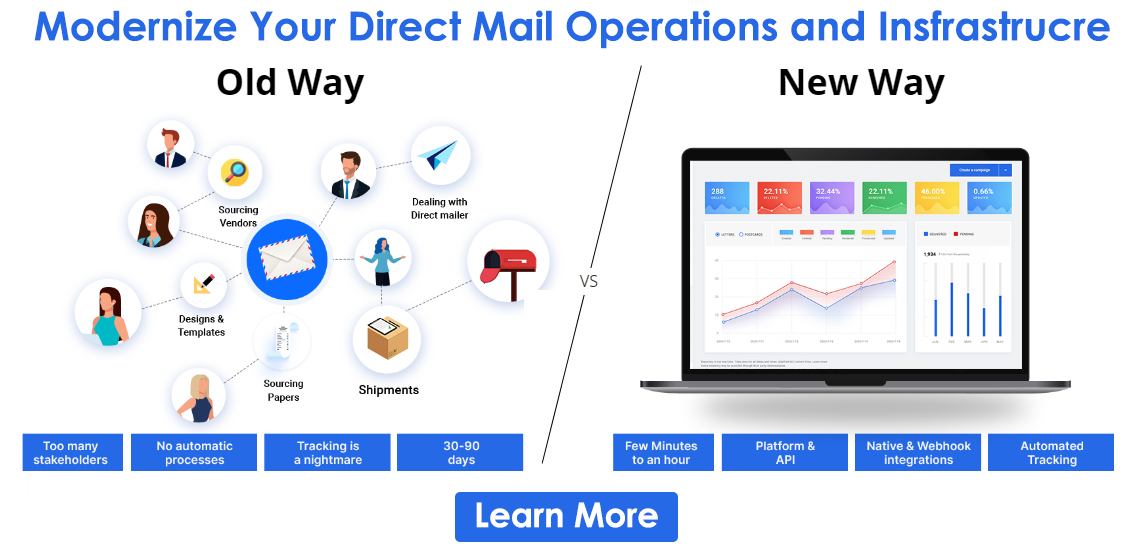
Businesses are often reluctant to use print marketing after considering the cost and hassle of creating and sending high-quality materials. PostGrid’s Print & Mail API provides an automated solution to design and mail fully personalized mailers on-demand at scale. You don’t need expensive printing machines, paper stock, and postage to set up your in-house mailroom. It is just like setting up an email campaign with the help of an API-first solution and a centralized dashboard for campaign management. We provide plenty of paper stock, mailing class, and collateral options to support your print marketing goals.
Sign up now to use professional printing with an automated solution.