


Ways to Measure Direct Mail Success
As per a study done by DMA, the response rate for direct mail marketing is five to nine times higher than that of other channels. Moreover, Sequel Response’s Direct Mail Marketing Benchmark Report reveals that 69% of consumers engage with direct mail pieces weekly, and one in three people do so daily. But have you wondered if there is a way to determine how engaging a piece is? How can you know your campaign gets a good response and prospects convert? For this, you need to calculate specific metrics and use the right tracking tools, which we will cover in this blog. You will also learn why it is essential to measure the impact of these pieces.

Key Takeaways
- It is important to measure how your direct mail campaign is performing. The data will help understand consumer behaviour, refine future strategies, and distribute budgets carefully.
- Specific metrics you must track are conversion rate, cost per lead, cost per acquisition, close rate, conversion rate, return on investment, average order, and lifetime value.
- Some techniques to know the impact of your piece are adding QR codes, PURLs, and distinctive phone numbers. You can also do A/B testing to determine which strategy will work.
- PostGrid Print & Mail API will automate the direct mailing and provide a dashboard to track the performance.
Benefits of Measuring Direct Mail Effectiveness
Assess Return on Investment (ROI)
By knowing the impact of your direct mail campaign, you can accurately determine the return you will get from your investment. You can track metrics like response rate, conversion, and revenue that these pieces generate to calculate the ROI. You can use this information to compare the success of physical mail pieces with other campaigns.
Optimise Future Campaigns
You can analyze the campaign performance to identify what is working and needs improvement. Accordingly, you can adjust future campaigns by refining targeting, messaging, and design elements. Metrics like customer acquisition costs and the response rate will help pinpoint the areas you can optimize for better results.
Understand Consumer behaviour
The analysis will reveal insights into customer preferences and behaviour. You can identify customer triggers, needs, and motivations by tracking KPIs like response rate and time taken to act. Knowing how different customer segments react to direct mail pieces will help you create personalized, targeted messaging that will improve engagement and conversion.
Allocate Budget Strategically
It will help you quantify and understand whether the mailer creates a more substantial impact than other marketing channels. If specific campaigns or strategies are underperforming, you can reduce the investment and reallocate the funds to those tactics that generate favourable outcomes. This data-driven approach will ensure you spend money wisely while enhancing overall marketing performance.
Segmentation Optimisation
You can pinpoint which audience segment responds best to the campaigns by analyzing metrics like response rate. You can use these insights to refine the target group precisely. Take, for instance, specific demographics that show stronger engagement. You can tailor your future campaigns to these groups, ensuring relevant and personalized communication.
Metrics to Measure Direct Mail Success
Response Rate
It measures the percentage of recipients who respond to the campaign by taking an action, such as a customer calling to enquire about a product or filling out a feedback or survey forms. A higher value indicates that the direct mail piece was successful in capturing the attention of the audience and moving them ahead. However, this will alone not provide a complete picture of whether or not the direct mail was a success. For instance, a campaign with high response rates might have a low conversion rate or a higher cost per acquisition rate. This is why it is essential to track other metrics to get a nuanced understanding of your direct mail performance.
Formula:
Response Rate= (Responses/Sends) * 100
If you want to measure the change in the response rate from a campaign, use the formula mentioned below.
(Response Rate With Direct Mail-Average Response Rate Without Direct Mail)/ Average Response Rate Without Direct Mail
Conversion Rate
You can quantify engagement with response rate, but conversion rate tells you how many interactions led to targeted action, such as purchase, sign-up, or subscription. It takes into account the quality of leads. A direct mail piece that attracts high-quality leads will have a higher conversion rate, even if the response rate is low. However, remember that various factors influence conversion rates, such as quality of offer, ease of purchase, and overall customer experience.
Formula
Conversion Rate= (Number of Customers Generated/Responses)*100
Use the formula below to measure the change in conversion rate from one direct mail piece to another.
(Conversion Rate With Direct Mail-Average Conversion Rate Without Direct Mail)/Average Conversion Rate Without Direct Mail
ROI
It provides the revenue generated from the campaign compared to the total cost of executing it. A higher value indicates that the strategy generates significant revenue at a reasonable price. A lower number signifies you need to take a different approach. Various factors impact this metric, such as the cost of production and distribution and the quality of offers.
Formula
ROI=(Revenue-Campaign Cost)/Campaign Cost
Cost Per Lead (CPL)
It is the amount spent to generate a single lead through a direct mail campaign. A lead is a potential customer who expresses interest in the product or service. Measuring this will help you spend efficiently and get quality leads, thus increasing the chances of conversion. If the CPL is high, it will signify poor targeting or ineffective mail design. You must refine your mailing list, test different offers, or personalize content to improve engagement and reduce costs.
Formula
CPL= Total Direct Mail Campaign Cost/Number of Leads Generated
Cost Per Acquisition (CPA)
It refers to the money you invest in acquiring a paying customer through the campaign. It will help you understand if you are gaining customers at a profitable cost to the business. It directly links CPL to actual sales. Hence, having a high CPL but a low CPA will indicate that the strategy effectively converts leads to customers. Additionally, the CPA should be lower than the average customer lifetime value to ensure the approach is financially viable.
Formula
CPA= Total Direct Mail Campaign Cost/Number of Customers Acquired
Close Rate (CR)
It refers to the number of prospects that became customers in comparison to the number of leads in the pipeline. A high number will bring down the CPA since more leads will become customers without additional costs. A low value, on the other hand, will indicate that your generated leads are not qualified or interested in the offer. If a campaign generates many leads but the conversion is low, you will have to improve lead nurturing, make offers compelling, and only send mail to interested prospects.
Formula
CR= (Number of Customers Acquired/Number of Leads Generated)*100
Customer Retention Rate (CRR)
It measures the percentage of customers who continue to do business with the company after a significant period of receiving the direct mail piece. It indicates the effectiveness of a campaign in engaging the customers and preventing churn. This also shows whether the strategy will drive long-term loyalty or just short-term engagement. Additionally, retaining customers is cheaper than acquiring them; hence, a higher CRR will reduce CPA. However, if the value is low, you must send tailored and enticing incentives and increase the frequency of your follow-ups.
Formula
CRR= {(Customers at the End of the Period-New Customer Acquired)/ Customers at the Start of the Period} *100
Average Order Value (AOV)
It indicates the average amount a customer spends on a product or service after receiving the mail. A higher value means your strategy is effectively generating larger transactions. This also helps identify and focus on high-value customers whom you can target with premium offers and exclusive deals. It will also give insights about the product generating higher revenue than others so that you can promote it more.
Formula
AOV= Total Revenue From Direct Mail Campaign/Number of Orders
Customer Lifetime Value (CLV)
It refers to the total revenue a business expects to earn from the customer throughout their relationship, which begins after sending the mail. The goal behind understanding this metric is to ensure long-term engagement. You can use it to determine how much you should spend on maintaining current customers and obtaining new ones. Calculating it is not as straightforward as other metrics, and you should follow the steps mentioned below.
- Average Purchase Value (APV): Divide total revenue collected in a certain period by the number of purchases at the same time.
- Purchase Frequency Rate (PFR): Divide the number of product purchases by the number of unique customers at the same time.
- Customer Value (CV): Multiply APV and PFR.
- Average Customer Lifespan (ACL): Divide the sum of all customers’ lifespan by the total number of customers
- CLV: Multiply CV and ACL.

Methods to Calculate the Effectiveness of Direct Mail
Front-End Tracking
This technique monitors and measures the initial responses and interactions that a direct mail piece generates. It focuses on how the recipient engages with the collateral before they make a purchase. Below are some of the popular front-end tools.
QR Code
You can use it to bridge the gap between physical and digital marketing channels. Place it near the Call-to-Action (CTA) and redirect the customers to an offer page or a landing page. Using the PostGrid Print & Mail API, you can add them to the direct mail materials and track them from the dashboard. Insights like how many people scanned the QR code, what their location was, and what action they took next can refine your future marketing efforts.
Personalized URL (PURL)
Using our solution, you can add unique and customized web addresses for individual recipients in the mailer and track them. These tools follow the customer’s behaviour online and provide exact data on website visits, time spent on the site, and conversion rate.
Unique Phone Numbers
You can assign a distinctive phone number to each campaign and track how many calls you receive. You can also add different phone numbers for varying customer segments and track which audience responds more. Similarly, you can do this for separate locations to determine which area generates the most traffic.
Back-End Tracking
This method measures what happens after the recipient responds to the direct mail piece. It focuses on conversions, retention rate, and ROI. It helps the business understand the full impact of the campaign. You can use tools like CRM tracking software, Google Analytics, and ROI analysis to get insights.
A/B or Split Testing
You can take two types of direct mailers with varying messaging, size, design, and format and share them with two customer segments. It will help you identify which piece is effective in generating new customers, retaining the existing ones, and providing a long-term profit.
Simplify Direct Mail Tracking With PostGrid Print & Mail API
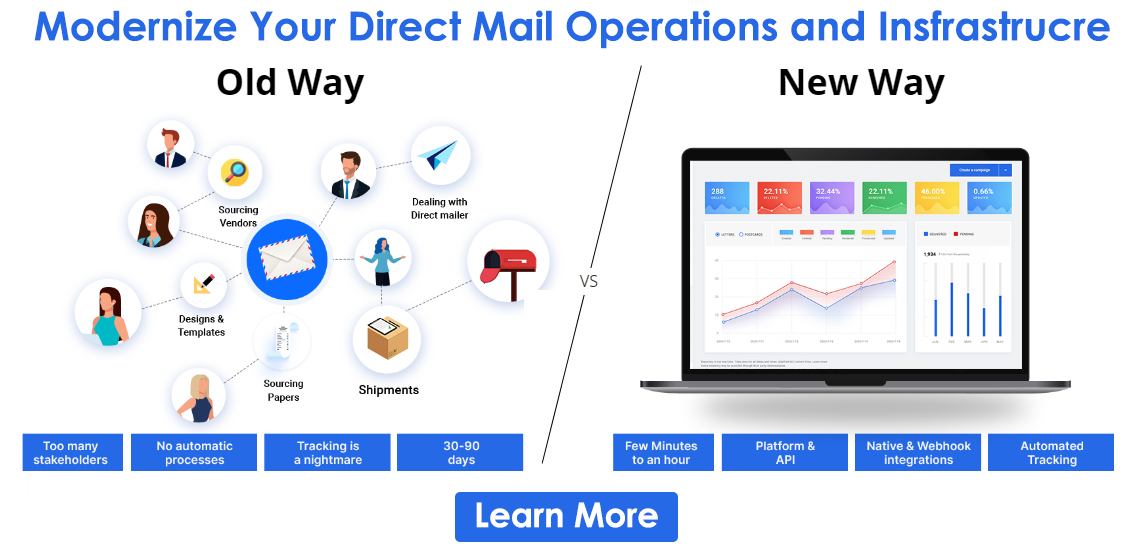
Understanding how to measure the effectiveness of your campaign is essential. However, managing the insights can be challenging without the proper tools and a centralized view. This is where PostGrid Print & Mail API can help you. We will integrate directly with your CRM, sales, and other tools to provide a unified view of your direct mail campaign’s performance. To see us in action, request a demo now.