

Direct Mail Management Services to Maximize ROI
Simpler. Faster. More targeted. PostGrid’s direct mail management software helps businesses reach the right households with cleaner data, smarter automation, and campaigns that are built to perform.

Direct Mail Campaign Management with Full Automation
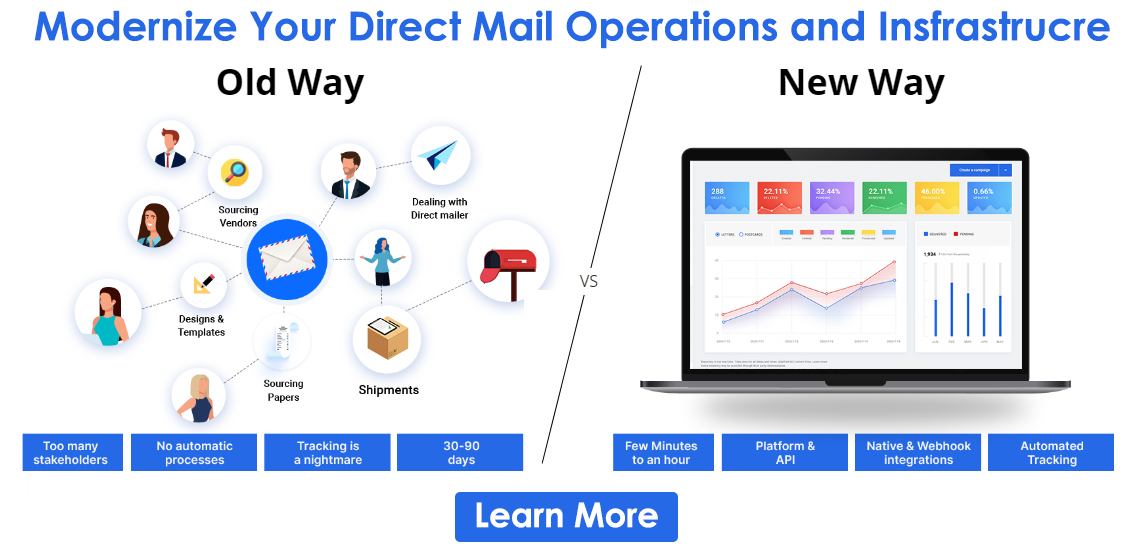
Every direct mail campaign runs on data and data is where most campaigns quietly fall apart. PostGrid’s direct mail management software specializes in data profiling, cleaning, capture, and automation so your campaigns reach the right people, not just any people.
From custom mailing lists to variable data printing, PostGrid helps you make well-informed business decisions and get the most out of your investment. Manage everything through a single dashboard.
With PostGrid’s direct mail management tools, you can:
- Target campaigns with a high degree of precision
- Send highly personalized, relevant mail to each recipient
- Deliver mail with strong physical tangibility directly to customers and prospects
- Run campaigns in versatile formats to suit different goals
- Measure campaign effectiveness with built-in analytics tools
- Complement your existing marketing efforts without disrupting your workflow
Your One-Stop Shop for Direct Mail
Direct mail marketing is a tried-and-tested channel. PostGrid’s platform lets organizations combine compelling direct mail with online response options, building the kind of customer relationships that actually stick.
Cross-Channel Marketing
PostGrid helps businesses engage audiences across multiple channels from one place keeping communication consistent and campaigns well-coordinated.
- Personalized & consistent communication
- Smooth CRM integration
- Highly targeted campaigns
- Improved relevance and timeliness
- Higher ROI
Direct Mail Marketing Tools
Whether you’re looking to retain existing clients or acquire new ones, PostGrid gives you enterprise grade tools to do it well:
- Improve response rates
- Communicate more effectively
- Use enterprise-grade infrastructure
- Omnichannel marketing support
- Variable data printing
Essential Correspondence
Transactional mail needs to be accurate, on time, and compliant. PostGrid makes sure it is every time.
- Full compliance with HIPAA, PIPEDA, SOC-2, GDPR, PHIPA, and more
- Complete process automation
- SLA compliance
- Multi-channel delivery
- Secure data transfer
Direct Mail Formats PostGrid Supports
PostGrid’s direct mail service covers four key formats, giving you flexibility depending on your campaign goals and audience.
Letters
Use our platform to send personalized letters online with the recipient’s name, address, and custom messaging for a personal touch. Letters work well for detailed communications that need depth and credibility.
Postcards
Creative postcards are a cost-effective way to promote products, services, or events. No envelope needed — your message is front and center the moment it’s picked up.
Self-Mailers
Eye-catching and informative, folded self-mailers are ideal for promoting a sale, product, or service. PostGrid manages the entire development, printing, and sending process.
Checks
Include checks in your campaigns for cash-back offers, reward programs, or transactional disbursements — all handled with enterprise-grade security.
Direct Mail Database Software: Solving the Data Problem
Having data from multiple sources is one of the biggest headaches in direct mail management. Different formats, duplicate records, and inconsistent entries make it hard to run clean, cost-effective campaigns.
Common problems with multi-source data:
- Duplicate entries that inflate campaign costs
- Difficulty evaluating the performance of individual campaigns
- Problems extracting usable data during campaign planning
- Higher error rates from manual data handling
- Increased costs from managing multiple IT platforms
PostGrid’s direct mail data management addresses all of this:
- Consolidates multiple data sources into one clean, unified source
- Removes duplicate records to save costs and reduce friction
- Improves your ability to qualify for postal discounts
- Full preparation and cleansing of data files to meet USPS address requirements
- De-duplication of records from your database
- Manages data capture and data entry
- Maximizes postal discounts through print, post, line haul, and consolidation
Use our Address Verification API alongside the platform to ensure every address in your list is accurate and deliverable before anything goes to print.
Features of PostGrid That Help Businesses
PostGrid’s direct mail API and management tools are built to help companies send targeted mail at any scale — while saving time, reducing manual effort, and improving response rates.
Omnichannel Marketing
Direct mail marketing with PostGrid doesn’t operate in a silo. You can fully utilize personalization and segmentation across both physical and digital campaigns. The platform lets you add direct mail triggers into your existing workflows, and you can include trackable QR codes, links, or redemption codes to feed engagement data back into your CRM.
Triggered Campaigns
Whether you run a subscription business or a retention marketing program, PostGrid lets you make triggered direct mail a natural part of your campaign workflows — sending the right piece at the right moment automatically.
Fully Testable Campaigns
Not sure which CTA, design, or message will perform best? With PostGrid, you can run A/B tests on direct mail pieces before committing to a full campaign send.
Highly Customizable
PostGrid’s custom template editor makes it easy for marketers to customize mail pieces with unique designs, messages, and concepts. Variable data printing lets you include each recipient’s name, address, salutation, and personalized messaging at scale.
Full Regulatory Compliance
PostGrid and its partners maintain full compliance with PIPEDA, HIPAA, PHIPA, GDPR, and SOC-2 certifications — ensuring your customer data is handled securely and confidentially at every stage.
Complete List Management
Upload and manage all your mailing lists directly in the platform. Segment lists by past purchase behavior, demographics, or any other relevant criteria to sharpen targeting.
Tracking and Analytics
Gain access to analytics tools that measure the real performance of your campaigns — including open rates, response rates, ROI, and conversion rates. Use our Direct Mail ROI Calculator to estimate returns before you even launch.
Integration with Other Software
PostGrid’s Print & Mail API integrates with your existing tech stack via Zapier — connecting to over 1,600 tools and CRMs without writing a single line of code. It also integrates directly with Salesforce, HubSpot, Marketo, and more.
Industries That Benefit from PostGrid’s Direct Mail Management Software
Retail
Promote products, announce store openings, offer discounts, and drive traffic to both physical and e-commerce storefronts.
Financial Services
Banks, credit card companies, and financial institutions use PostGrid to promote services and attract or retain customers.
Healthcare
Hospitals and clinics share services, educate patients on treatments, and encourage appointment scheduling through targeted healthcare direct mail.
Non-Profits
Encourage donations, promote volunteer events, and raise awareness for causes through well-managed physical mail campaigns.
Real Estate
Realtors and brokers use real estate direct mail marketing to promote listings, offer deals, and build their brand.
Education
Schools, colleges, and universities promote programs, encourage enrollment, and reach students with scholarship opportunities.
Hospitality
Hotels, resorts, travel companies, and restaurants advertise venues, special events, and exclusive discounts.
 Also Read: Canada Post FlexDelivery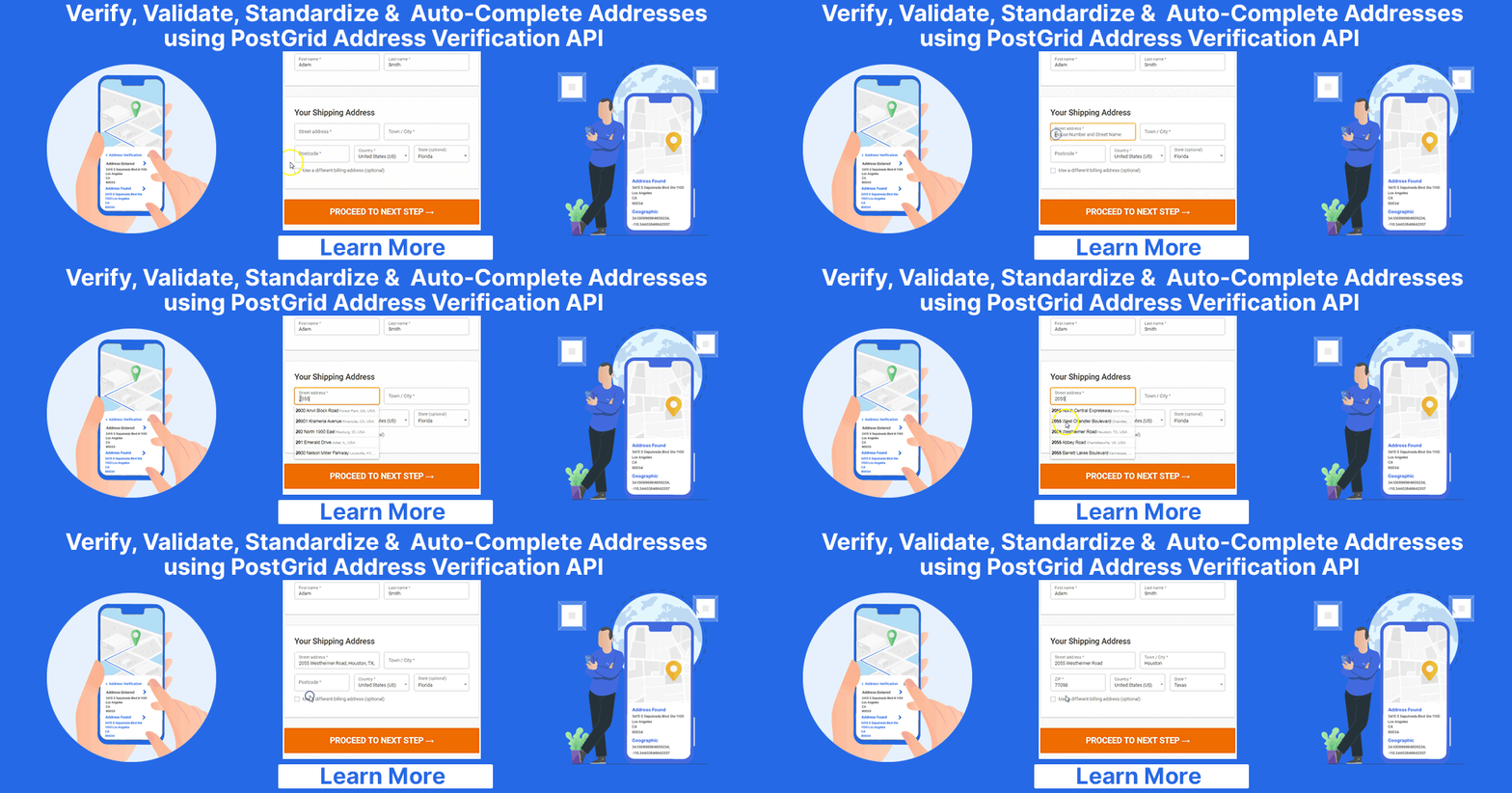
How to Automate Your Direct Mail Campaigns with PostGrid
Step 1: Understand Your Campaign Needs
Study where your current cross-channel marketing could be stronger. This helps you identify exactly where automated direct mail fits — and where it will have the biggest impact.
Step 2: Verify Your Address Information
A poor address database means missed deliveries and wasted spend. Run your lists through our Address Verification API to automate address accuracy before campaigns launch.
Step 3: Integrate PostGrid with Your Existing Systems
Connect your current tech stack to the Print & Mail API to automate the processes that matter most to your workflow.
Step 4: Configure Campaign Triggers and Go
Define which actions or events trigger direct mail printing and posting. Once direct mail is embedded in your marketing workflow, every campaign becomes more relevant, more timely, and more personalized — automatically.
Enterprise-Grade Security & Compliance
PostGrid holds certifications across the major compliance frameworks:
✓ HIPAA ✓ SOC-2 ✓ PCI ✓ PIPEDA ✓ PHIPA
Your data — and your customers’ trust — is protected at every step. Learn more about our security.
Ready to Get Started?
Start transforming and automating your offline communications with PostGrid.
[ Sign Up ] [ Request a Demo ] [ Talk to Sales ]
More Resources
FAQs
Does Canada Post deliver parcels to your door?
Yes, for addresses that still receive door-to-door service and items that require a signature or are too large for a community mailbox compartment. However, roughly 75 per cent of Canadian addresses are already served by community mailboxes, and the remaining 25 per cent are being phased over in the coming years. Oversized parcels requiring a signature will still come to the door regardless of address type.
Does Canada Post deliver to apartments and condominiums?
Most apartments and condominiums have a group letterbox or Canada Post parcel locker unit in the building’s lobby or mailroom. Canada Post delivers to these communal areas rather than individual unit doors. For oversized parcels that do not fit in the parcel locker, the carrier will attempt door delivery to your unit; if no one is home, a Delivery Notice Card is left for post office pickup.
Will Canada Post still deliver to my door during the 2026 transition?
If you currently receive door delivery, nothing changes immediately. Canada Post will notify residents in writing well before any conversion affects their neighbourhood. The transition will be phased in over three to nine years, with most conversions expected within the first three to four years. You will receive advance notice before your address is affected.
What if I have a disability or mobility issue, will I still get home delivery?
Yes. Canada Post’s Delivery Accommodation Program provides continued home delivery for Canadians who face barriers to accessing a community mailbox due to functional limitations or health conditions. You need to apply and provide supporting documentation. Canada Post has also confirmed other accommodations are available, such as adjusting the height of a mailbox compartment or installing sliding trays. If you think you may qualify, it is advisable to contact Canada Post before a conversion reaches your neighbourhood.
What happens if I miss a Canada Post delivery?
Canada Post will leave a Delivery Notice Card in your mailbox. You have five business days to collect the item from the designated post office. A final notice is then issued, followed by a 15-day hold period before the item is returned to the sender.
Can I choose where Canada Post delivers my packages?
Yes. Canada Post’s free FlexDelivery service lets you designate a participating post office as your delivery address. You sign up online through the Canada Post website or mobile app and are assigned a unique FlexDelivery address. When an item is shipped to that address, you receive a notification and collect the parcel at your chosen post office at your convenience. This is particularly useful if you work away from home during delivery hours or want a more secure option for high-value parcels.
Will letter mail take longer to arrive?
Likely, yes, for non-urgent letter mail. As part of its transformation plan, Canada Post has relaxed delivery standards for regular letter mail from two to four business days to three to seven business days. Some letter mail now travels by ground rather than air. Urgent items and parcels are not affected by this change.