
How to Manage Complexities of Global Addresses?
Managing global addresses is a huge headache for businesses. Most countries have different address formats, making it more challenging to run operations internationally. Unnamed roads, unmarked buildings, and unclear navigation data are the common complexities of global addresses. An international address validation software is vital to validate, interpret, and fix large volumes of addresses from multiple countries.
They have close relationships with each country’s official postal address database to provide the most accurate and up-to-date information. Using address verification tools can drastically improve customer service, delivery rates, and savings for a business. This blog will help you understand how to manage the complexities of global addresses with these solutions.

Key Takeaways
- Businesses often experience huge amounts of confusion when managing global addresses.
- An official postal service hosts the address database of the respective country.
- The rising global trade highlights the importance of accurate address data.
- Individuals have a hard time interpreting addresses due to language barriers.
- Geolocation technology provides precise geographic coordinates to locate an address.
- International addresses are constantly updated every day.
- Real-time address verification helps to reduce errors and save time.
How International Address Formats Work
A standard U.S. postal address has zip codes, states, and cities. However, address formats could be different in various parts of the world. These differences make it harder for businesses to start and run their operations globally. Some countries even have unnamed roads and unmarked buildings, making it challenging to acquire accurate address data.
All this creates a huge confusion among individuals and businesses managing international addresses. It is unfeasible to remember all the formats and verify databases manually. In most countries, the postal address format has a street name, a house number, a postal code, and the name of a locality or a municipality.
Each country has its own official postal service that hosts a database of verified addresses. For example, USPS (U.S.), Royal Mail (UK), Canada Post (Canada), La Poste (France), and Australia Post (Australia). This database could be useful for sorting the mail and fixing possible mistakes. However, may not have this authoritative database.
Why Is Managing Global Addresses Important for Businesses?
Despite the astonishing growth of mapping and navigation technology, businesses often face logistical challenges while getting goods from A to B. The hardships become even bigger when the destination points are inaccurate or incorrect.
Address data isn’t only for logistics. It can also improve customer experience and business productivity in the customer journey. Businesses operating overseas need accurate address data to ensure healthy customer relationships by delivering products and services on time.
Customer retention is everything for a business to grow sustainably. A study by Brain & Company research suggests that a 5% increase in retaining customers can mean as 95% increase in profitability. Precise address data also helps in billing, shipping, and fraud prevention.
What Are the Complexities of International Addresses?
Address Formatting Across the World
Most of the international addresses look different from one another. Structured verification and address formatting is a highly intricate process for global addresses. For example, a company operating in the Japanese market needs to start its address by entering its postal code first. At the same time, businesses in France need to put the building number before the street name. In Germany, you need to write the street name along with your academic title.
Language Barriers
English may be spoken in so many countries as a global language. However, many countries still have their native tongue as the official language of the state. Businesses want to start and run their operations in multiple regions for global expansion.
There are 249 countries and territories with over 3000 languages and 139 character scripts. You will have a hard time managing addresses in different languages. However, consumers prefer businesses that prioritize their native tongue. A checkout experience with local formatting shows your commitment to understanding the region. It is challenging to verify and standardize international addresses present in multiple languages manually.
Complex Interpretetion
Only a highly trained professional can interpret global addresses. Even some of the simplest systems can be challenging to some. Take a look at this address example,
What Strategies Can Businesses Use to Effectively Manage Global Addresses?
Address to International Databases
Data quality is the most critical factor to ensure accurate international addresses. This is only possible when you have access to the authoritative databases of the respective countries. Many providers may host address data in their native country. However, you should trust a provider that has good tie-ups with global data resources, such as USPS, Canada Post, Royal Mail, and Australia Post.
Utilize Geolocation Technology
Last-mile delivery requires more than a postal address. Consider a huge residential complex, how will you identify a specific flat if the address doesn’t have an apartment number? Geolocation technology gives you precise coordinates (longitude and latitude) to pinpoint the address on a map.
Constantly Update Your Address Database
Around 14.4% of Americans move yearly, according to the US Census Bureau. This number could be hugely different in each country. Obsolete address data could lead to lost or failed deliveries. You should constantly update your database with the respective country’s postal authority.
Ensure Fuzzy Matching
People can easily make mistakes while entering their addresses. It could be anything from mistyping a word to missing a word entirely. Your address verification method should support fuzzy matching to counter this problem. It would allow you to find and fix common typos and errors as customers enter their addresses. The system automatically corrects the users to only accept the official format of the respective country.
Use Software With Transliteration
As you know different countries have unique native tongues. Their character sets will also be different from Latin script. An address verification service provider with transliteration feature allows users to input address data in a familiar alphabet.
For example, the system would automatically character sets such as Russian, Arabic, or Hebrew to similar-sounding letters in either native or Roman characters. It makes the interpretation of postal addresses much easier for businesses and customers.
Why Do You Need an Address Specialist?
Most businesses and professionals underestimate the challenges of managing postal addresses. However, this ignorance could soon lead to catastrophic losses, reputational damage, and even legal battles.
International addresses aren’t static; they are constantly changing every day. Buildings can be built, streets can be renamed, and geographical boundaries can also change. It highlights the need for an automated solution that helps you verify, validate, and standardize international addresses in real-time. An address specialist improves the accuracy of data in real-time and reduces errors in addresses. Businesses can also fix formats based on location requirements.
Reliable and consistent international address validation is necessary to fulfill your global customers. An address specialist could be a go-to partner for reaching hundreds of countries, improving relationships, saving money, and bringing higher conversions.
How Can PostGrid Help You Manage Global Addresses for Your Business?
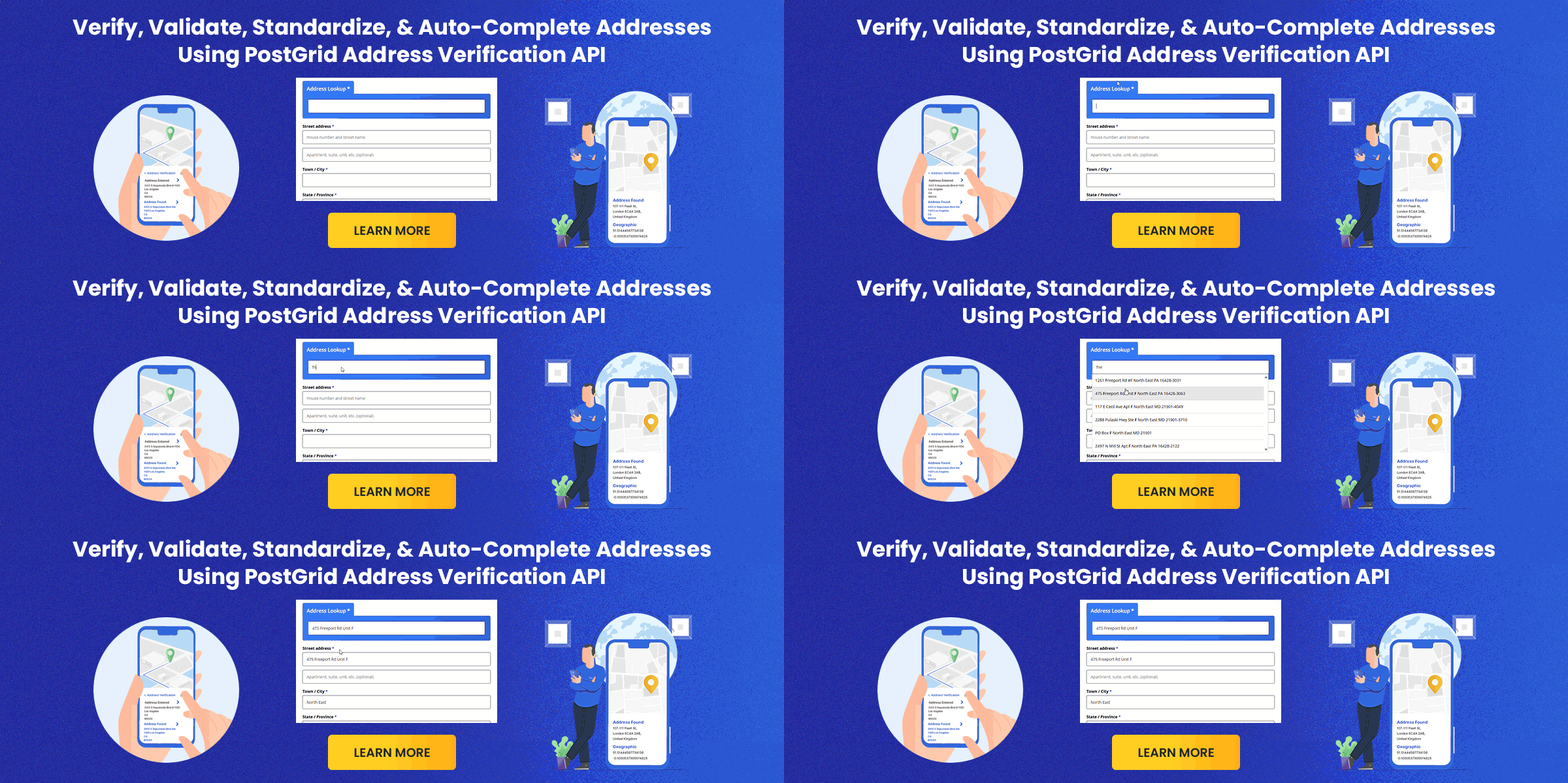
International address validation requires accuracy and speed. PostGrid Address Verification API provides a comprehensive suite of tools to verify, validate, standardize, autocomplete, and cleanse global addresses from 245+ countries and territories. You get verification capabilities in real-time to fix and validate your global address database.
We update our databases regularly, feature reverse geocoding, and offer transliteration features, making global address verification a breeze. The API also gives you enriched premise-level data, including apartment or suite numbers, street details, or zip codes. It is necessary to enable businesses to target international audiences easily from their home country without any cross-border complications. Sign up now to manage complex global addresses efficiently.