

Manual vs Automated Cheque Deposit: How Automation Reduces Processing Time
Cheque payments are still relevant in the age of digital payments and cryptocurrencies. But one might wonder about manual vs automated cheque deposit, which one is better? How can you save a trip to the bank and continue transactions?
Because of compliance and business preference, check payments are here to stay. So, we need to upgrade our approach to process them. Many businesses are already reducing processing time with automation. This blog is the perfect place to understand the difference between manual and automated cheque deposit. Also, we explore how we can change the way you process checks with virtual mailbox services.
Key Takeaways
- Manual cheque deposit involves receiving paper checks in your mailbox and handing them to a bank branch for clearance.
- Paper checks are relevant due to compliance and the preference of some businesses.
- manual vs automated cheque deposit is a common debate among business owners looking for a reliable payment method.
- Remote cheque depositing lets you skip the trip to your bank or ATM, but you need to scan incoming checks and upload images to a portal manually.
- Automated cheque deposit is more convenient, efficient, secure, accurate, and cost-effective than manual deposits.
- The Check Clearing for the 21st Century Act is a federal legislation that allows remote deposit capture.
- A virtual mailbox provider opens and processes checks immediately with minimum human intervention from your side.
What Is a Manual Cheque Deposit?
It refers to the process of receiving paper checks in your mailbox or by hand. Then, hand over those checks to a bank for clearance. You must fill out a deposit form and deposit funds at your bank. Still, we need to talk about manual vs automated cheque deposit.
Individuals and businesses have been using this method for over two centuries. In fact, the first use of paper checks dates back to the 9th century. It was the most popular non-cash payment method throughout the 20th century.
Even today, many use manual cheque deposit whenever they receive paper checks. It is a preferred payment method where an automated cheque deposit doesn’t work.
How Manual Cheque Deposits Work? Why They Still Matter?
The fundamentals behind “What are manual cheques?” are simple. You’ll go through a process like this;
- Receive a paper check.
- Travel to a bank branch or ATM in person.
- Fill out a deposit form.
- Communicate with a teller, bank associate, or a deposit box.
- Water for the funds to arrive in your account.
After all, the process isn’t complicated, but rather time-consuming. There are multiple stakeholders and processes during the clearance. Also, you might have heard about remote cheque depositing.
This is the best option when you want to skip the trip to your bank or ATM. You use a mobile banking app to scan your physical cheque. Then, upload it to their portal. However, there is still a clearance process you will face.
Are you wondering what is “manual cheque meaning?” These deposits are relevant even today. Many businesses still prefer the old-school method of processing payments. In fact, you might encounter many vendors or clients willing to pay via manual cheques. Besides, some business owners don’t have enough resources to implement automated systems.
Manual cheque deposits are a tried and true method for transactions. So, it might be unnecessary for some businesses to set up automatic cheque deposits. However, automation could still change the way they transfer money with minimal investment.
What Is Automated Cheque Deposit?
It refers to scanning and depositing checks without much human intervention. Automated cheque deposit could be the perfect option for businesses that receive high-volume checks. They can rely on a digital solution to scan, endorse, and deposit them automatically with no effort.
How Automated Cheque Deposit Works?
Automated cheque deposit will work best when you are using a virtual mailbox solution. Any hybrid or remote business would like to avoid the effort of handling checks manually. So, they can decide to receive physical cheques on their virtual mailbox to save time and get convenience.
The virtual mailbox provider will scan any incoming check, notify you, and endorse it as well. Besides, you can direct them to which bank account you’d like to receive the funds. Automation has an edge in the manual vs automated cheque deposit debate.
The provider primarily uses remote deposit capture for automated cheque deposits. After all, this technology has been available at your bank for several years. However, the involvement of a mailbox provider takes it to the next level. It can also endorse checks on your behalf. The provider connects to your business bank account with the help of API integration.
Business providers can focus on their core operations instead of processing checks. Besides, it only needs a simple initial setup. Then, you can guide the provider about your preferences.
💡Also Read: Automated Cheque Printing & Mailing Solutions
Manual vs Automated Cheque Deposit: Direct Comparison
Investing in an automated cheque deposit solution could be a strategic move for your business. But can we draw a proper comparison between manual vs automated cheque deposit before that?
Convenience and Efficiency
Today’s dynamic business environment demands efficiency and convenience above anything. Fortunately, the days of physically visiting the bank to clear checks are fading away.
Automated cheque deposit services are bringing next-level banking experience for businesses. You only need a scanned image of the front and back of a check. Then, you upload it to a server for clearance. It removes the need to visit any bank or ATM. Also, you update the updates and records for deposits digitally.
We cannot forget the location factor in the check clearance process. Manual cheque deposit requires you to spare time and visit your local branch. In comparison, automated cheque deposit lets you manage finances virtually from anywhere.
You only need access to a working internet connection, and you’re good to go. So, your funds are usually available in your account within hours. Any business would like to have a better cash flow to grow and maintain continuity.
Better Security and Accuracy
Modern businesses expect robust financial transactions with the assurance of security and accuracy. They can’t afford to have errors in check payments and lose any funds. Manual cheque deposits are prone to theft and tampering. In fact, anyone might intercept the check and try to change the information.
This is where automation gets an advantage in the debate of manual vs automated cheque deposit. They reduce the risk of losing or damaging checks. So, you don’t have to worry about losing a check in transit or at the office.
Manual cheque deposits are always prone to tearing, stains, cuts, or water damage. In contrast, your digital mailbox provider will scan your incoming checks digitally and upload them. So, all your checks are safe and secure.
You also think about manual data entry in manual cheque processing. It is often the primary source of errors and inaccuracies. What kind of mistakes, you may ask. Transposition errors, misread characters, and manual erasures are some common errors. Results? Incorrect payments and increasing complications.
An automated cheque deposit solution is the answer to these problems. It uses Optical Character Recognition (OCR) technology to capture information from a scanned check. So, there’s no risk of human errors or intervention. Your accounting department doesn’t have to spend additional time spotting mistakes. It further gives an edge to automation in the debate of manual vs automated cheque deposit.
Cost and Productivity
Next, you need to consider cost and productivity when processing checks. These are primary reasons why businesses are moving towards digital payment methods. For instance, manual cheque depositing eats up your company’s resources.
You need a dedicated staff for sorting mail, opening envelopes, analyzing checks and slips, and processing them. Then, they will finally need to visit the bank in person for clearance. As you can see, a lot of time-consuming administrative tasks.
When you use an automated solution, it cuts down staffing costs, supply costs, and banking fees. So, your team can focus on strategic functions instead of monotonous tasks. Using automation also means better access to transactional data on your CRM systems directly. You can keep an eye on your funds and cash flow.
Record Keeping and Reporting
Manual cheque deposit also needs manual record-keeping. It could easily overwhelm your staff, especially when you handle high-volume check transactions. Besides, your team work in silos to maintain records for the organization.
Automated cheque deposit helps you cut down on human dependency in this process. Most virtual mailbox providers offer integration options. So, it helps in audit trails and financial visibility. All your data is synced in real-time to save your time and effort.
💡Also Read: Safest Way to Send a Cheque Through the Mail
Why Is Automated Cheque Deposit a Critical Tool for Modern Businesses?
You should know that automated cheque deposit is more than just a convenience. It is clearly changing the way we use check payments. How does it make automation a better option in manual vs automated cheque deposit?
Growing Check Volume and Lack of Time
A global business ecosystem means receiving more and more checks. Despite the growth of digital payments, check payments are more prominent than ever before. So, manual cheque depositing means more headcount in your organization. Automation is a necessity to keep up with this growing volume without hiring additional staff.
The Need for Flexibility Among Remote and Hybrid Teams
Manual deposits mean having an in-house mailroom at your office. Also, you need someone to be physically present to deposit the checks. This model is only ideal for traditional businesses with physical workplaces. Remote and hybrid teams need better flexibility to avoid the need for physical presence.
The check will still arrive at some location even if you use remote deposit. Someone has to receive it, scan it, and send it to the bank. However, using a virtual mailbox solution skips these complex steps and helps you enjoy flexibility. The provider handles the entire check-clearing process while you and your team are working remotely.
Cash Flow Visibility and Speed
Automated cheque depositing ensures faster deposits and funds availability. The virtual mailbox provider opens and processes checks immediately. So, there’s no waiting for someone to visit the bank or click pictures for uploads. The difference between manual vs automated cheque deposit gives you better access to capital. For this reason, your business stays worry-free about cash forecasting.
💡Also Read: How to Read a Canadian Cheque
Security Measures That Make Automated Deposits More Secure Than Manual Deposits
Data Encryption
A reliable virtual mailbox uses strong end-to-end encryption technology to protect your data. So, all your data remains safe and confidential during automated cheque deposit. It works by breaking down the data into tiny bits that’re almost impossible to decode. This level of security is applicable to both your check images and bank account details. After all, you want peace of mind when handing over your banking information to a third party.
Strict Role-Based Access Controls (RBAC)
You want control and restrictions over who can access your checks. A trusted virtual mailbox offers RBAC to let you define roles and permissions over your mailbox. So, only authorized team members can access and manage incoming checks. It adds another layer of security to your banking transactions. Businesses with multiple team members need to do this to limit unauthorized usage.
Audit Trails
Each automated cheque deposit should generate a visible digital trail. This information becomes handy in future audits or dispute resolution. It gives another point to automation in manual vs automated cheque deposit. So, your virtual mailbox provider should use time stamps, check images, and deposit details to maintain these trails. As a result, you have complete records to review in case of any issues or disputes.
Custom Deposit Limits and Holds
You should have complete control over your bank account and funds. To ensure this, some providers give you the option to set custom deposit limits. So, you keep your account safe without exposing it to potential fraud or mistakes.
💡Also Read: Address Checker: Verify Postal Addresses
What Is an eCheck? How Do They Work?
An electronic check is a digital version of your paper checks. These checks withdraw funds from the payer’s checking account electronically. Moreover, an echeck uses the ACH network to deposit the funds into the payee’s account.
The Automated Clearing House (ACH) network is responsible for processing payments among U.S. financial institutions. This payment infrastructure can withdraw payments for goods or services from an individual’s bank account.
Electronic check processing is very similar to paper check processing. However, it is a much faster way of processing checks. Technology allows us to make this happen electronically, while saving time and reducing paper waste.
- Request Authorization: The business has to get authorization from the client before initiating the transaction. It usually takes an online payment form, phone conversation, or signed order form.
- Payment Set-up: After this, you will need to add the payment information to an online payment processing system. Besides, mention of the recurring schedule if it’s a recurring payment.
- Finalize and Submit: Click on “Save” or “Submit” depending on the software to initiate the ACH transaction process.
- Deposit Funds: The ACH protocol automatically withdraws funds from the customer’s bank account. Also, the customer will receive a payment receipt.
Where to Deposit Your eCheck?
- Mobile Banking App: It is the most common place to scan and upload your checks electronically.
- ATM: Some ATMs have OCR technology to process electronic deposits of eChecks.
- Bank Branch: It defeats the entire purpose of echecks, but your bank branch should also accept these checks.
Common Automated Cheque Processing (ACP) Issues
Automated Cheque Processing (ACP) is a critical part of the ACH ecosystem. Together, they enable same-day check processing. However, there could be some issues with ACP and ACH.
Availability of Funds
It might be difficult for some banks to manage the influx of check-clearing requests without prior notice. For example, a small financial institution might not have sufficient funds to process digital checks with large amounts of money. So, your automated cheque deposits might stay on hold for a few hours or days. In such situations, you may need to notify the bank, credit union, or loan house beforehand.
Technical Issues
The whole banking infrastructure relies on the internet to work. For this reason, any server malfunction and downtime might block automated cheque deposits from clearing. You need to consider these issues to time your checks for deposit.
Human Errors
Sometimes, automated cheque deposits can also have misspellings and incorrect user information. Then, missing MICR data can also force the system to bounce your check. The transaction might take longer than the expected time.
Complex Financial Regulations
Financial compliance laws can vary in different countries. So, it means complications when sending money between two international banks. For example, US banks might withhold a check from a foreign bank or a country under sanctions. These blockers can potentially block the flow of transactions.
💡Also Read: Digital Checks vs. Paper Checks: Full Comparison Guide
Things to Note Before Using Automated Cheque Deposit
Remote or mobile deposit might seem like a simple method to deposit your checks electronically. However, you need to take a closer look to understand its limitations.
Banks Have a Limit on Mobile Deposits
Most banks have a limit on the total amount of mobile deposits. This limit depends on your bank, limiting you from high-volume check transactions. However, this limitation is necessary to reduce the risks of fraudulent cheque deposits. So, you should visit your bank to increase the limit. For this reason, automation is better when comparing manual vs automated cheque deposit. The mailbox provider does everything for you to process your checks.
Your Online Check May Bounce
Yes, there’s a possibility of your check bouncing. Mobile deposits can also bounce when the issuer doesn’t have sufficient funds in their account to transfer. So, you must keep this in mind while confirming a deposit to your bank. Besides, a bounced check can have a negative impact on your bank account. Also, your bank has the right to reverse funds even after a successful transaction.
Check Information Is Kept Private
The check image can have sensitive financial information. So you can’t afford to leak it, just like physical cheques. For this reason, banks secure your deposit data on an encrypted web server. You also need to follow the best security practices to keep the information safe.
The Bank App Must be Capable of Taking Clear Pictures
Use a reliable app to take clear snapshots of your checks. For this, you will need a monochromatic background for a detailed and sharper picture. Then, position the check correctly to complete the capture process.
Retain the Paper Check With You After the Deposit
It’s always a good practice to keep your paper checks for record-keeping. Most people retain them until they reflect in their online account statement. Besides, it may be possible that a bank might ask for the physical cheque to confirm details.
Why You Should Consider PostGrid’s Print & Mail API for All Your Automated Cheque Deposits?
As you can see, automation is the clear winner in manual vs automated cheque deposit. It saves your time and lets you focus on other critical tasks. PostGrid makes automated cheque deposit as simple as possible.
Our comprehensive virtual mailbox solution lets you manage all incoming mail via a digital dashboard. It enables you to manage incoming mail via scanned images. Besides, we provide you with a unique physical address to receive mailings. So, you don’t have to worry about your physical location while processing checks. However, we are more than a virtual mailbox solution for checks.
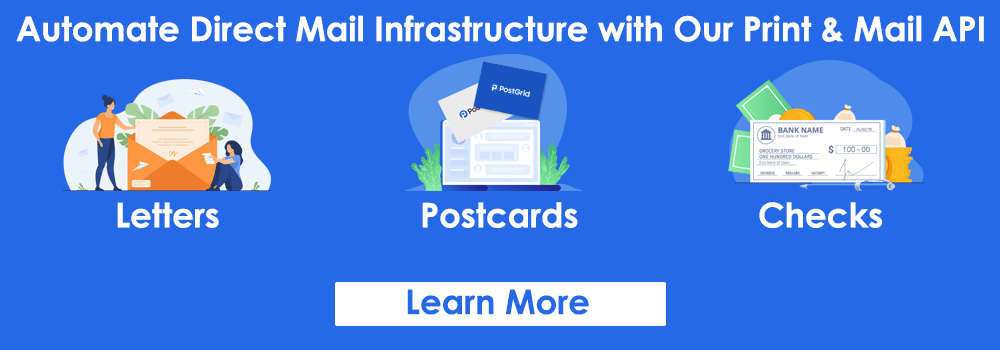
You can expect a fully scalable API to create, print, and send letters, postcards, and checks with automation. After all, native integrations let you sync data in real-time with your CRM, ERP, or marketing automation tools.
Sign up now to enjoy automated cheque deposit with virtual mailbox services.